


The objective of the Swedish program Vision Zero (Zero deaths) can be described in one sentence: no one should die in an accident. Gradually this idea extends to other countries of the world, although it does not always go smoothly. Conversations about traffic safety often result in accusations of victims, recommendations to wear light-tight vests and not use the phone during crossing of the street.
In 2016, the vice mayor of Toronto seriously stated that all the troubles are due to pedestrians who contrantly use their phones, listen to music in headphones and cross the street wherever they like. All these despite the fact that the authorities of the city formally adopt Vision Zero.
Officials generally say a lot about reducing the death rate in road accidents, but they often do not understand how this is done at all. They forget about the main thing - design matters. This truth has already been learned in many European countries, and in Holland this principle has been followed for several decades. Back in the 1980s, the police of Utrecht found that measures aimed at reducing dangerous accidents are not effective, and made the right conclusion: "If the rules do not work, they need to be changed." If drivers constantly exceed the speed, it's not the drivers, but how the street design problem. "Before fining violators, we first need to understand how many of them are around. If the proportion of violators is high, fines will not help here - it is necessary to make sure that speeding on this site becomes impossible, " local newspapers wrote in those years.
Invented in Sweden, the Vision Zero program is based on the same principle, so its implementation requires a new attitude to the problem of lethal traffic accidents. We must admit that a person is imperfect, and no rules and penalties will change this.
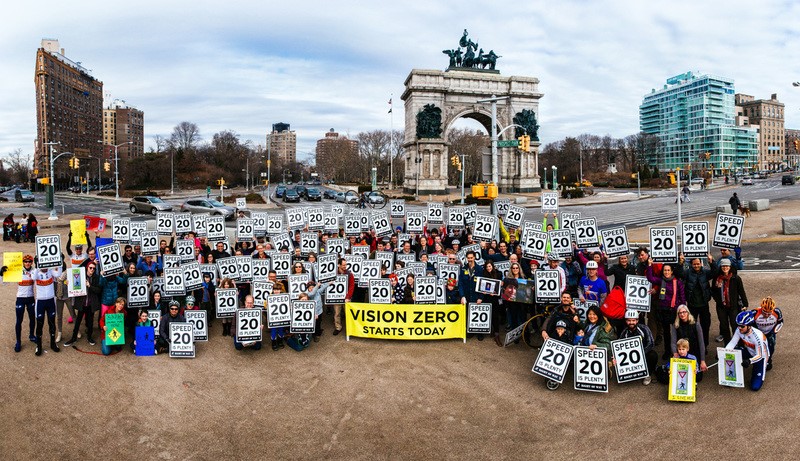
The action in support of Vision Zero in New York. Source: vaccaroandwhite.com
In the transport system of the cities of North America, Russia, CIS and other countries, where they have not yet mastered the new principles, there is a mortal danger. Our streets are designed to provoke drivers to risk, which they can not control. We are entangled in the cause-effect relationship and accuse the victim of the tragedy. We do not pay attention to real threats, concentrating all our attention on such trifles as music in headphones, smoking, passengers and etc. And we continue to make mistakes - the human factor is always present, 365 days a year. An efficient transport system must take this into account.
Instead of introducing new stupid rules that prohibit pedestrians from writing sms and improving their "behavior", one must look at the root: there is no such thing as an "incident" on the road - there are problems that need to be addressed.
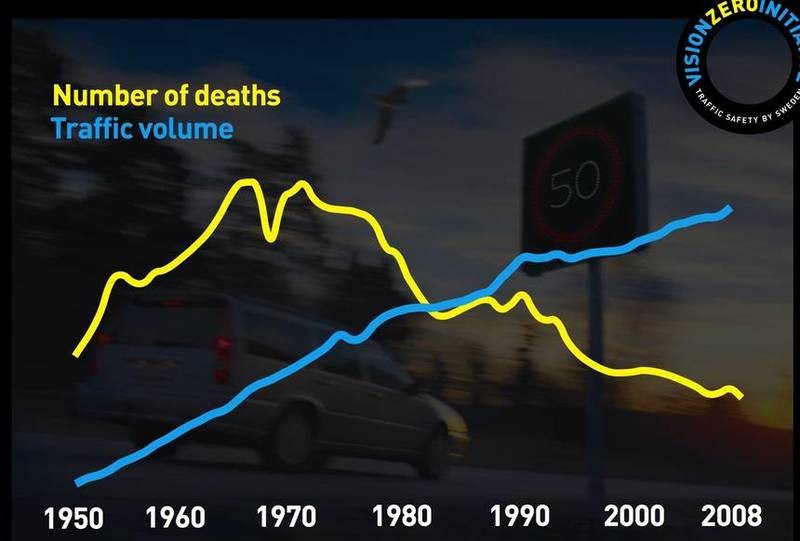
Swedish statistics show the effectiveness of this approach: the blue line indicates the number of trips by car, and the yellow one indicates the number of victims of road accidents. Source: visionzeroinitiative.com
New York is one of those cities where they try to take seriously the ideas laid down in Vision Zero. But at the same time they not only try to design safer streets, but also proceed from the fact that some people behave maliciously. For example, they deliberately violate the speed limit and do don’t look where they turn. Therefore, they reduce the speed limit and impose fines for those violation. However, this does not work well - laws can not replace good design. For example, if you take a street with a speed limit of 60 km/h and build it as a highway, this street will be a source of massive violation of the rules, the environment itself will provoke drivers to exceed the speed.
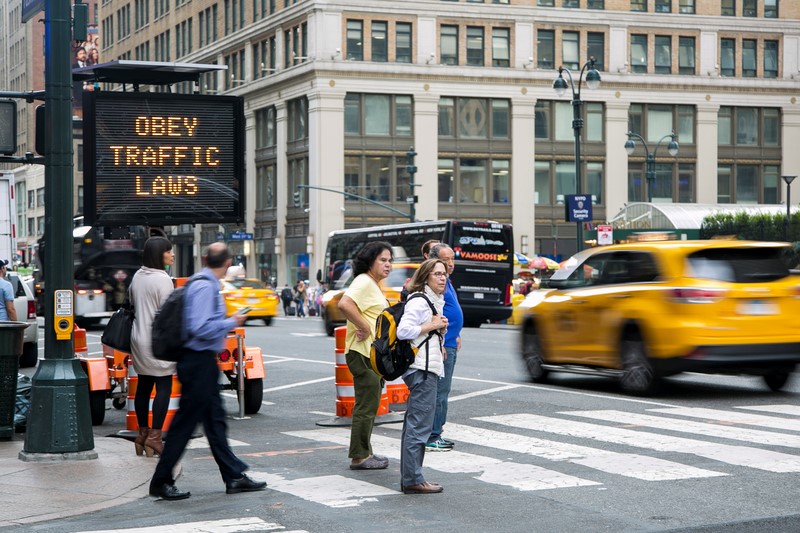
New York. Source: theepochtimes.com
These principles are also understood in New York, therefore they try to make the streets equally convenient for different users. For example, you do not have to stomp a kilometer in search of a place to cross the street – crossings are arranged in the most popular places. Planners try to divide the flows of cars, cyclists and pedestrians. They equip the streets with islands of security for the convenience of less mobile people.
Vision Zero requires an integrated approach. And before the commentators accuse me of defending the right to text in the middle of the street, I will say that this is not about this. You cannot introduce a law against stupidity. People text in the middle of the street, people write them at the wheel - it happens all the time. Perhaps in order to combat this dangerous phenomenon, we should completely prohibit walking and driving. Old people also need to be banned - they move as slowly as teenagers, who are buried in the screens of their mobile phones and make up 65% of the victims in Canada. This fully corresponds to today's approach to the organization of traffic, when all the forces are directed at ensuring that drivers can reach the house three minutes earlier. Instead of taking care of everyone getting home safe and sound.